Research Philosophy & Programs

I am an interdisciplinary researcher who identifies primarily with the field of Information Systems (IS) while drawing upon reference disciplines such as computer science, organizational behavior, and social psychology. My work explores how emerging digital technologies shape and are shaped by human, organizational, and societal contexts.

At the core of my research philosophy is the conviction that technology design and deployment are never purely technical pursuits. As IS researchers, we must illuminate the intricate relationships between technologies and their socio-organizational environments and consider how they transform work, governance, and collective decision-making.

My orientation as an informatician reflects this commitment to understanding technology as a human and social endeavor.

In recent years, my research focus has evolved from studying socio-technical systems to specifically examining AI-enabled socio-technical ecosystems, where algorithmic agents now participate alongside humans in producing, sharing, and interpreting information. This progression links my long-standing interest in digital transformation and information integrity with emerging questions of AI literacy, governance, and resilience.

Research Programs

My research draws upon diverse theoretical and methodological traditions, combining conceptual modeling, empirical inquiry, and design-oriented studies. The following clusters summarize the main strands of my established and ongoing research programs.

This research program examines how humans and AI systems work together in organizational and educational contexts. It investigates the skills, literacies, and cognitive processes that enable people to use AI tools productively, ethically, and critically. The work explores how AI literacy translates into AI competency and how collaborative human-AI workflows reshape knowledge work, creativity, and professional learning.

Select Contributions:

Research Grants:

This program explores the challenges posed by online misinformation and disinformation and the tools and strategies to mitigate them. It includes the study of narrative intelligence – the use of AI and natural language processing to detect, analyze, and counter harmful digital narratives. The research contributes both conceptual frameworks and empirical evidence to strengthen organizational and societal resilience against information manipulation.

Select Contributions:

Research Grants:

  • MITACS Grant: Automated Regulatory Compliance Analysis for Canadian Organizations (2025 - 2026).
  • MITACS Grant: Advocacy-focused, AI-Enabled, Stakeholder Relationship Management System (2024 - 2025).
  • MITACS Grant: Functionality & Usability of Digital Disinformation-Countering Technologies (2023).
  • Canadian Heritage Grant: Comprehensive Evaluation of Online Disinformation-Countering Tools: Gap Analysis & Recommendations for Educational & Technological Interventions (2021 - 2022).

This emerging research stream focuses on building organizational capacity to prepare for, respond to, and recover from cyber threats. It emphasizes the integration of risk management, architecture, and governance into a broader cyber resilience paradigm that combines technical safeguards with leadership and organizational learning.

This applied research stream explores blockchain-enabled business models and digital ecosystems. It examines how distributed ledger technologies create value through transparency, accountability, and interoperability across organizational networks. Supported by multiple MITACS grants and industry partnerships, this work has produced both conceptual frameworks and real-world applications.

Select Contributions:

Research Grants:

  • MITACS, GRID (Geo-Registry Integrated Datachain): Blockchain Enabled Land Registry (2022 - 2023).
  • MITACS, Blockchain Enabled Land Registry: Towards Improving Transparency, Accountability & Compliance (2018 - 2019).

This research investigates how individuals and organizations adopt and use digital health technologies such as online personal health records (PHRs) and patient portals. It explores sociotechnical factors influencing trust, adoption, and perceived value, as well as the spread of health misinformation online.

Select Contributions:

Research Grants:

  • MITACS, Enhancing Clinical Documentation through Large Language Models (2024-2025).
  • Telfer School of Management, Drivers and Barriers for the Deployment and Adoption of Online Personal Health Records in Canada (2011-2013).

This program connects information systems research with the scholarship of teaching and learning. It explores how digital tools, social media platforms, and learning analytics can be used to enhance engagement, experiential learning, and personalized education in higher-education contexts.

Select Contributions:

Research Grants:

Summary Highlights

Research Funding

$350K+ as Principal Investigator (PI); $225K+ as Co-Investigator or Collaborator.

High-Impact Publications

Multiple publications in high-impact journals; Multiple highly cited references.

Applied Research Outputs

Patents for blockchain systems; Industry collaborations for applied research in AI; Commercialization of gamification design recommendations in multiple products; Adoption of pedagogical frameworks and guidelines by institutions around the globe.

Integration of Research and Teaching

Development of AI-literacy and cybersecurity curricula, experiential simulations, and analytics-driven pedagogy.

Supervision and Mentorship

Active supervision of PhD and MSc research on human-AI collaboration, narrative intelligence, and digital transformation strategy.

Significant Contributions & Research Impact

DORA Signatory Badge

Commitment to Responsible Research Assessment: I am a signatory to the San Francisco Declaration on Research Assessment (DORA), which advocates for responsible and meaningful evaluation of scholarly contributions. While traditional bibliometric indicators such as journal impact factors, h-index, and citation counts provide one dimension of research visibility, I believe they offer an incomplete and often misleading picture of research quality, relevance, and societal impact. My approach to research assessment emphasizes a richer, more holistic framework that recognizes the diverse pathways through which scholarship creates value—from disciplinary advances and methodological innovations to practical applications, policy influence, and public engagement.

The impact of my research extends well beyond academic citations to encompass tangible real-world outcomes and societal contributions. My work has informed the commercialization of products and services, including patent applications and direct influence on product design in industry. I have engaged extensively with media and public discourse, participating in numerous newspaper, radio, and television interviews on topics ranging from social media dynamics and blockchain technology to human-AI collaboration and digital transformation. These engagements have helped bridge the gap between academic research and public understanding, making scholarly insights accessible and actionable for broader audiences.

My research contributions have also influenced policy and practice in meaningful ways. I have served as an expert witness in court proceedings where my research has been cited to provide evidence-based perspectives on technology-related matters. I have been invited to serve on advisory boards, including the Conference Board of Canada, where academic insights inform strategic decision-making in organizational and policy contexts. Additionally, I have been engaged in disseminating research findings to non-academic audiences (e.g. corporate clients, technology users, and industry professionals), helping organizations adopt evidence-based best practices in digital strategy, data analytics, cybersecurity, and AI integration.

Drawing upon DORA's TARA framework (Tools to Advance Research Assessment), my research outcomes can be mapped across multiple dimensions of impact. These contributions span disciplinary advancement through highly cited peer-reviewed publications, collaborative and advisory roles through interdisciplinary research and industry partnerships, and scaled societal influence through commercialization, policy impact, and public engagement. The diversity of these contributions — reaching audiences from academic peers to industry practitioners, policymakers, and the general public — demonstrates the broad and lasting value of research that embraces both scholarly rigour and real-world relevance.

Selected Significant Contributions

Reference Bibliometric Indicators Impact Indicators & Real-World Influence
Nault, K., Ruhi, U. (2023) "User Experience with Disinformation-Countering Tools: Usability Challenges and Suggestions for Improvement", Frontiers in Computer Science, 5:1253166
SJR: Q1
IF: 2.4
CiteScore: 4.3
Part of Canadian Heritage funded research initiative examining digital disinformation threats and technological countermeasures.
Khan, M. L., Malik, A., Ruhi, U., Al-Busaidi, A. (2022) "Conflicting Attitudes: Analyzing Social Media Data to Understand the Early Discourse on COVID-19 Passports", Technology in Society, 68:101830
SJR: Q1
IF: 10.1
CiteScore: 17.9
FWCI: 4.52
RCR: 2.77 (Highly Cited)
Widely cited for robust social media discourse analysis informing policymakers and healthcare providers about public health intervention efficacy during COVID-19 pandemic.
Ruhi, U., Chugh, R. (2021) "Utility, Value, and Benefits of Contemporary Personal Health Records: Integrative Review and Conceptual Synthesis", Journal of Medical Internet Research, 23(4):e26877
SJR: Q1
IF: 5.8
CiteScore: 14.4
RCR: 1.98 (Highly Cited)
Outcomes include advisory role with two hospitals in Ontario, Canada for recommendations to improve functionality and adoption of patient portals.
Sultan, K., Ruhi, U., Lakhani, R. (2018) "Conceptualizing Blockchains: Characteristics & Applications", Proceedings, 11th IADIS International Conference on Information Systems, Lisbon, Portugal
Conference Paper
FWCI: 7.98 (Highly Cited)
  • Early academic paper formally describing core functions and business value proposition of blockchain technology
  • Highly cited for definition and conceptualization of blockchain in IS research
  • Patent: Blockchain-based real estate registry patent (Australian Patent #2021107214, August 2021)
  • Patent Application: Blockchain-based real estate registry patent (U.S. Patent Application #17/619,184, September 2022)
Chugh, R., Ruhi, U. (2018) "Social Media in Higher Education: A Literature Review of Facebook", Education and Information Technologies, 23(2):605-616
SJR: Q1
IF: 4.8
CiteScore: 10.0
FWCI: 23.46 (Highly Cited)
Guidelines adopted by various institutions globally to enhance teacher-student and student-student interactions through social media platforms in higher education contexts.
Ruhi, U. (2016) "An Experiential Learning Pedagogical Framework for Enterprise Systems Education in Business Schools", International Journal of Management Education, 14(2):198-211
SJR: Q1
IF: 7.4
FWCI: 1.63 (Highly Cited)
Recommendations implemented in experiential learning programs at multiple institutions including University of the Free State (South Africa) and Fluminense Federal University (Brazil).
Ruhi, U. (2015) "Level Up Your Strategy: Towards a Descriptive Framework for Meaningful Enterprise Gamification", Technology Innovation Management Review, 5(8):5-16
FWCI: 13.27 (Highly Cited)
Commercialization Impact:
  • Research applied in Centrical's gamification and microlearning platforms
  • Collaborated with company design team to integrate research insights into product development
  • Delivered webinar to corporate customers (June 2017) disseminating research-based best practices
Detlor, B., Hupfer, M., Ruhi, U., Zhao, L. (2013) "Information Quality & Community Municipal Portal Use", Government Information Quarterly, 30(1):23-32
SJR: Q1
IF: 10.0
CiteScore: 18.4
FWCI: 23.66 (Highly Cited)
Informed design of municipal e-government portals in various municipalities in Ontario, Canada to enhance citizen engagement and service delivery through improved information quality and usability design principles.

Media Engagement and Public Scholarship: I have participated in over 20 media interviews across multiple platforms — including CBC Radio, CBC Television, CTV News, Toronto Star, Globe & Mail, Financial Post, and international outlets — discussing topics such as COVID-19 public health strategies, telecommuting and remote work, social media dynamics, privacy and security, blockchain technology, and AI integration in education. These engagements translate scholarly research into accessible insights for diverse audiences, contributing to informed public discourse on critical technology and society issues.

PRISM Lab

At the Telfer School of Management, I lead the PRISM Lab – People, Resilience, Intelligence, Security, Meaning, which is a research and innovation group that explores how technology can empower human capability and organizational resilience in a rapidly changing digital world. Our research examines how emerging digital technologies can be designed and deployed towards enabling adaptive human capabilities, resilient organizations, trustworthy ecosystems, and meaningful transformation. Drawing on perspectives from information systems, human-computer interaction, AI governance, and cybersecurity, the lab connects academic research with practical applications in business, education, and society. It serves as a collaborative environment for collaborating researchers, graduate students and industry partners to explore human-centered approaches to digital transformation and responsible technology innovation.

Learn more about the Lab's ongoing projects and collaborations here.

Other Research Affiliations

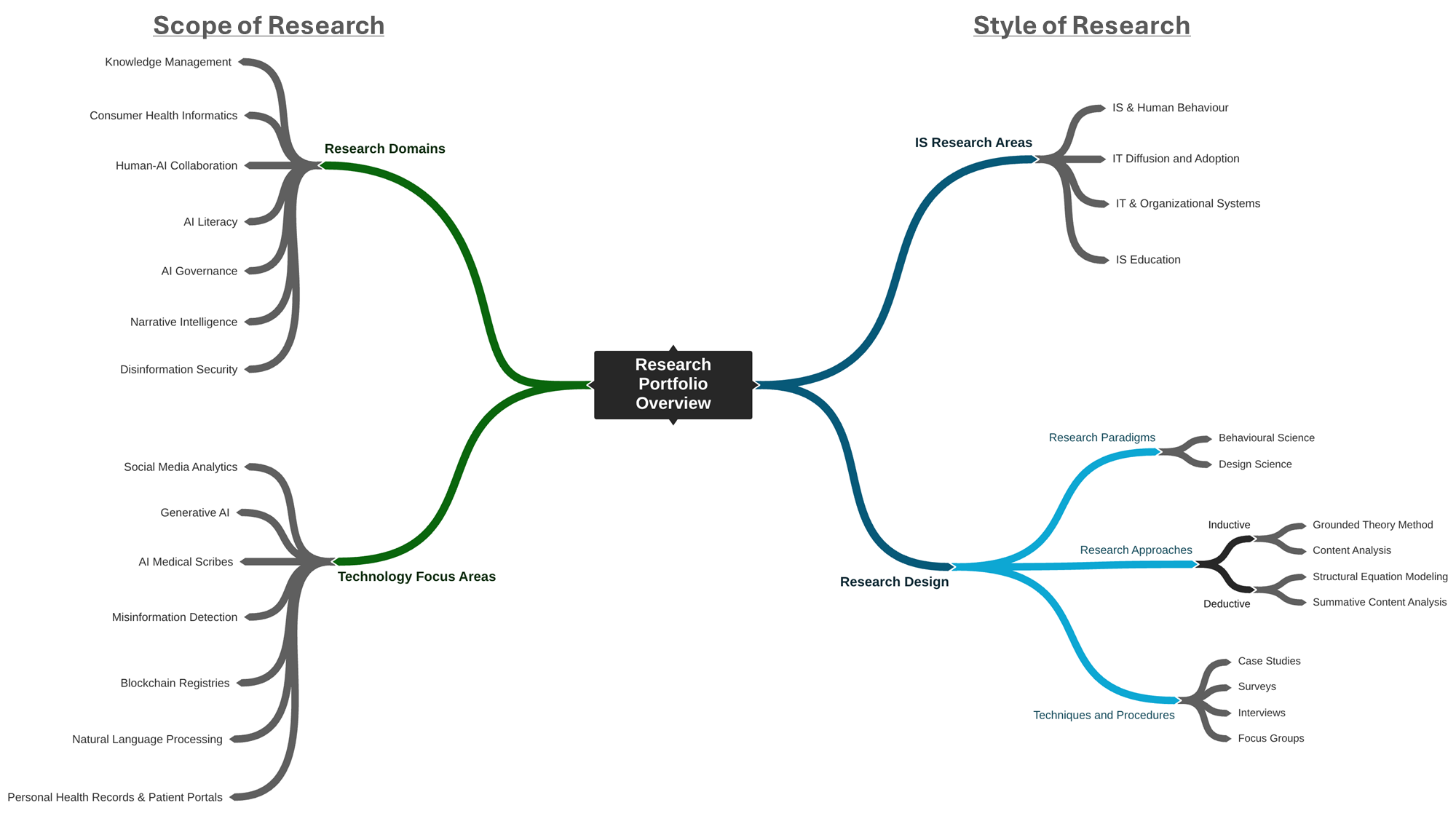
Research Portfolio Overview

The following mindmap provides a visual overview of my research portfolio, illustrating the scope of research domains and technology applications on the left, alongside the methodological approaches and research paradigms that guide my work on the right. Click the image to view a larger version.

Research programs mindmap showing scope and style of research

Click to enlarge: Research domains, technology applications, and methodological approaches